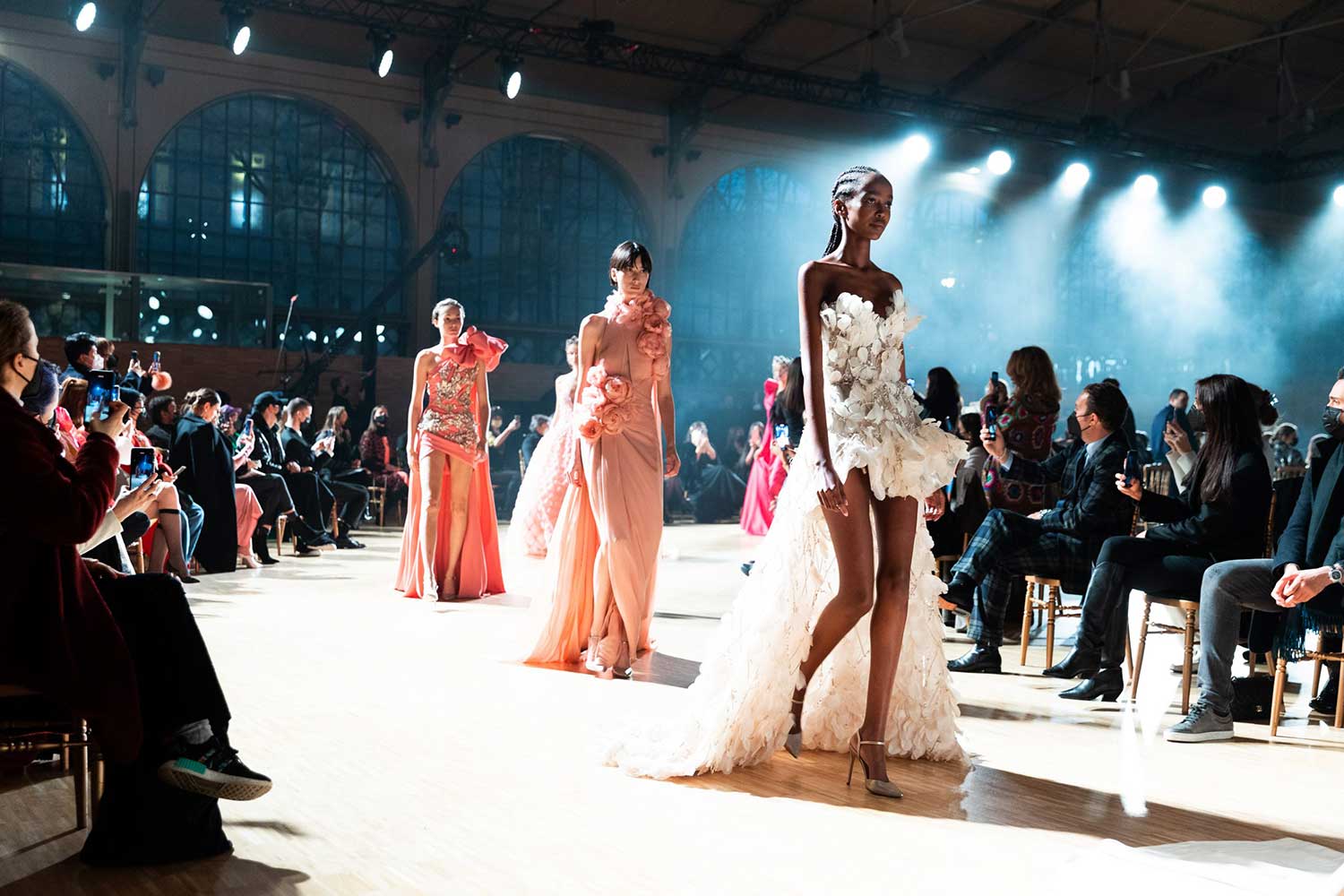


The 10 Highlight Shows at Paris Fashion Week SS27
-
 Nancy
Nancy - Published on Oct 07, 2026
 Nancy
Nancy 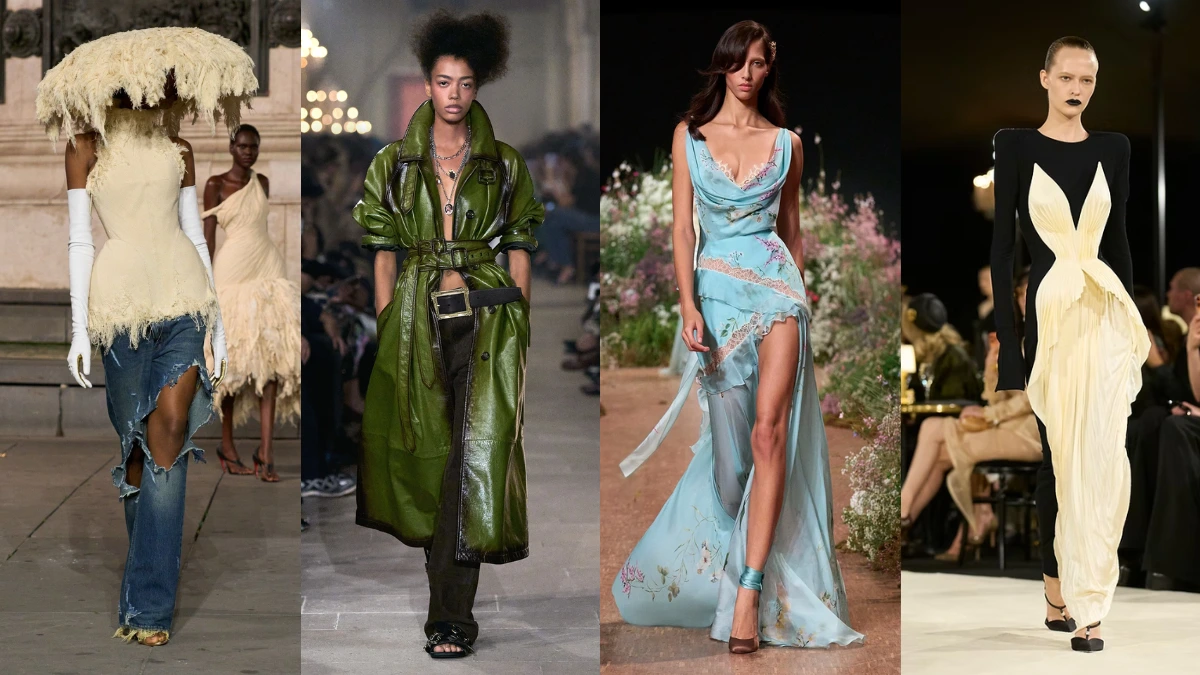
Contents
- 1. Dior makes the New Look feel lighter
- 2. Chanel proves Matthieu Blazy’s vision has momentum
- 3. Saint Laurent turns the runway gold
- 4. Acne Studios turns 30 years of denim into controlled chaos
- 5. Schiaparelli makes surrealist glamour easier to wear
- 6. Maison Margiela brings experimentation closer to reality
- 7. Elie Saab turns lingerie dressing into modern Old Hollywood
- 8. Balenciaga finds beauty in pragmatism
- 9. Valentino turns the library into a fashion statement
- 10. Matières Fécales makes the political personal
- What connected the standout Paris Fashion Week shows?
- Experience Paris Fashion Week with MA Hospitality Group
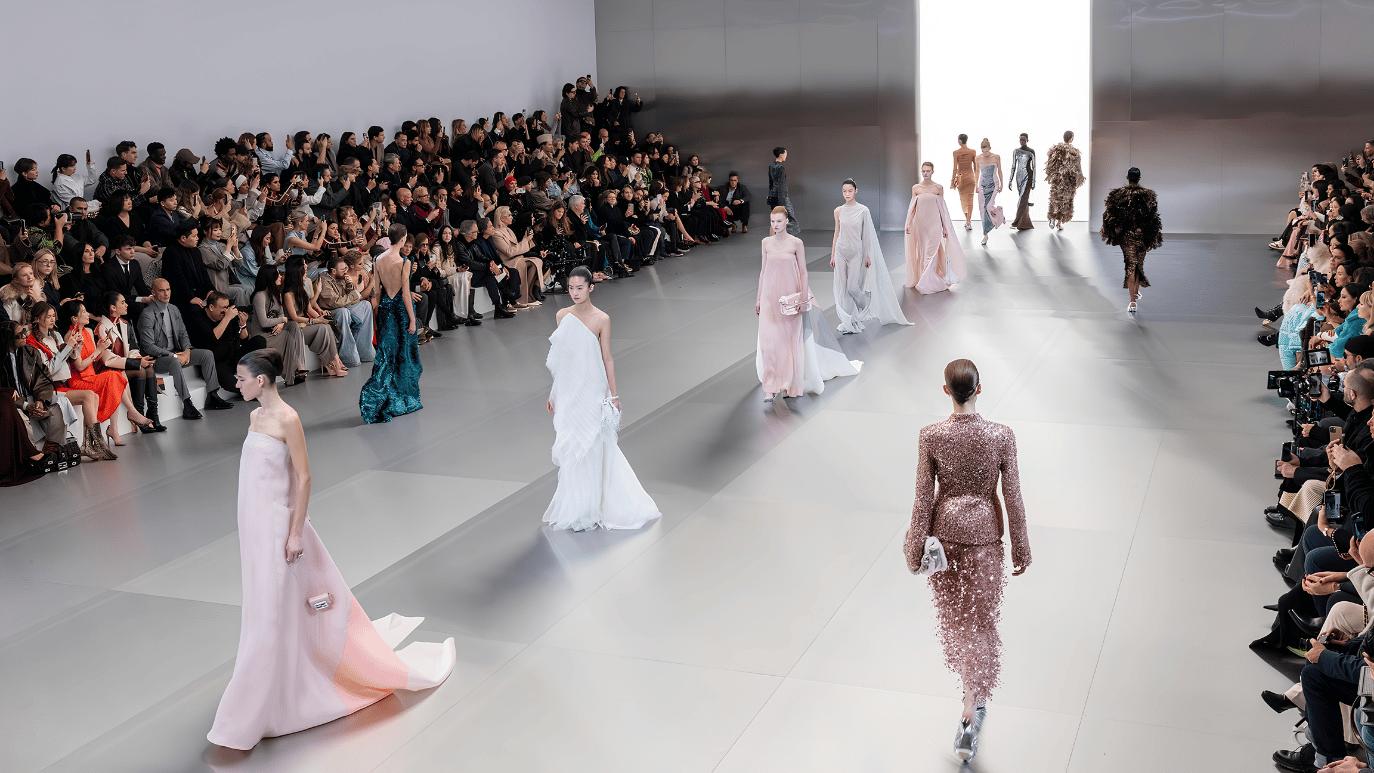
Paris Fashion Week SS27 highlights reflected a wide range of ideas rather than one dominant aesthetic. The Spring/Summer 2027 season closed Fashion Month with 68 shows and 34 presentations, spanning heritage houses, experimental labels, romantic glamour, and political statements. From Dior’s lighter New Look to Acne Studios’ denim experiment, the standout shows captured the diversity and key Paris Fashion Week trends shaping SS27.
1. Dior makes the New Look feel lighter
Jonathan Anderson used one of Dior’s most recognisable signatures as the starting point for a surprisingly modern proposition. Instead of treating the Bar jacket and full circle skirt as untouchable pieces of fashion history, he stripped away their visual and physical heaviness.
Chiffon became central to the collection. Pinstripes and tweed effects appeared on near-transparent fabrics, while the famous fitted Dior silhouette was softened into something less constricted. Tiny layered skirts, delicate florals, utilitarian khaki, and relaxed shirting created a wardrobe that referenced the house’s past without becoming trapped by it.
Paris’s unusually warm weather made Anderson’s approach especially timely. One of the biggest PFW SS27 highlights was therefore not only Dior’s romanticism, but its attempt to make luxury lighter, more mobile, and better suited to contemporary life.
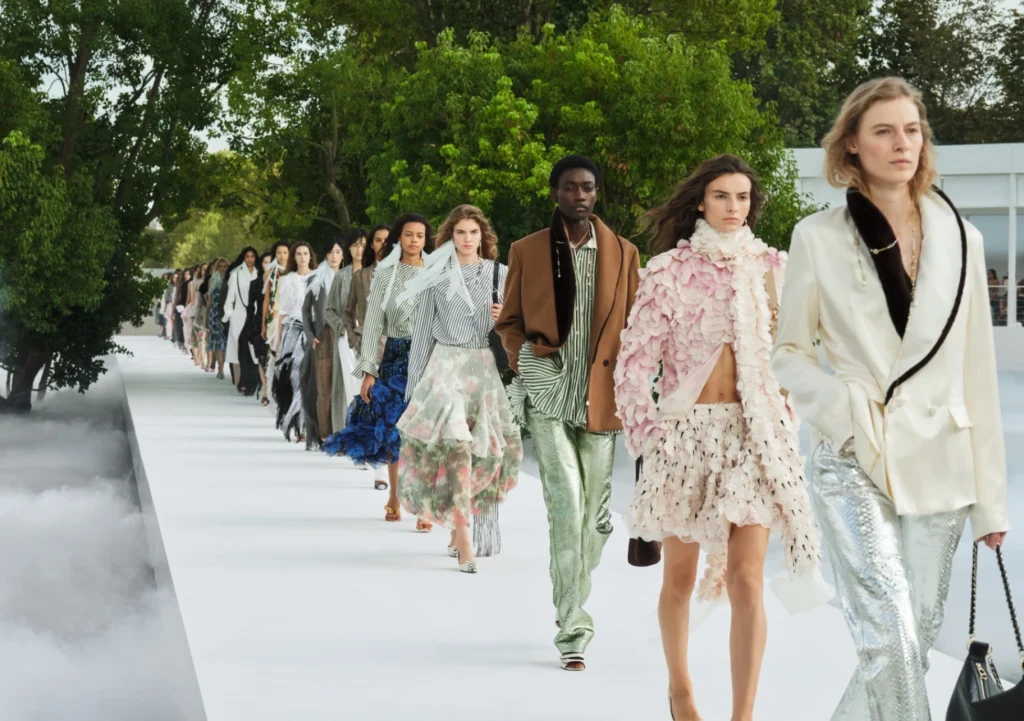
Dior SS27
2. Chanel proves Matthieu Blazy’s vision has momentum
Blazy softened Chanel’s traditional formality while preserving its signature codes. Tweeds, skirt suits, rounded silhouettes, and craftsmanship remained central, while birdsong, feathers, and sculptural details gave the collection a lighter, more individual feel.
The footwear alone became a talking point: all 83 runway looks were paired with different shoes. That level of variation made accessories an important part of the collection’s personality rather than simply a commercial add-on.
Among the biggest Paris Fashion Week SS27 highlights, Chanel stood out because the house no longer feels as though it is simply introducing a new designer. Blazy is increasingly building a recognisable Chanel world of his own.
3. Saint Laurent turns the runway gold
If Dior pursued lightness, Saint Laurent embraced pure visual drama.
Anthony Vaccarello’s SS27 collection arrived almost exactly 10 years after his first show for the house and was built around Yves Saint Laurent’s fascination with gold. Metallic Sahariennes, trenches, brocades, lace, oversized jewellery, and extremely high heels transformed the runway into one of the most glamorous Paris Fashion Week shows of the season.
The setting amplified the effect. Candlelit chandeliers hung above a glossy black runway while the Eiffel Tower sparkled in the background. One of the collection’s most talked-about accessories was a pair of heels supported by sculptural snake-shaped forms, reinforcing the sense that accessories were becoming fashion statements in their own right.
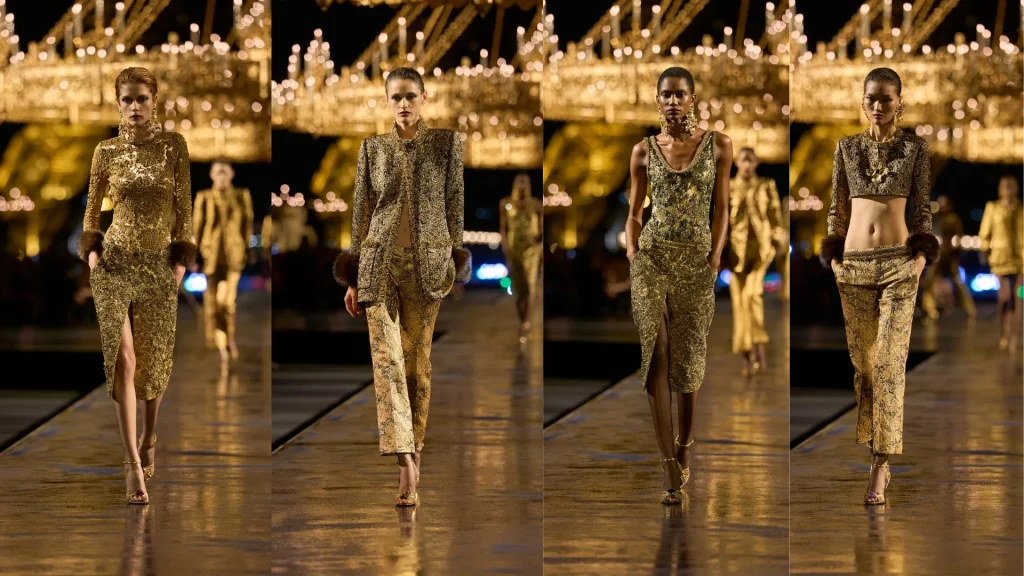
Saint Laurent SS27
4. Acne Studios turns 30 years of denim into controlled chaos
Acne Studios stood out at Paris Fashion Week SS27 with Denim Hystoria, a collection that revisited the brand’s 1996 five-pocket jeans while mixing in Renaissance, Baroque, pirate, and 1980s New Romantic references.
The most unexpected inspiration was the Vasa, Sweden’s elaborately decorated 17th-century warship that sank on its maiden voyage. Johansson used the ship as a metaphor for creative excess, asking how much can be added before something becomes overwhelmed by its own ambition.
That idea ran through the clothes themselves. Enormous skirts layered over jeans, while historical prints, portrait brooches, ribbons, buckles, puffed volumes, leather, and faded floral surfaces created a sense of deliberate overload. Yet denim remained the anchor, keeping the collection firmly connected to Acne Studios’ identity.
5. Schiaparelli makes surrealist glamour easier to wear
Schiaparelli delivered one of the season’s most atmospheric shows, presenting Spring 2027 like an intimate nightclub. Guests sat at small tables beneath chandeliers while Barbra Streisand played over the speakers, setting an immediate after-dark mood.
Daniel Roseberry revisited the Schiap jacket, translating Elsa Schiaparelli’s surrealist, art-led approach to tailoring into a more contemporary wardrobe. Sculptural details, evening pieces, and theatrical references remained central, but the collection felt more grounded than purely fantastical.
That balance made the show especially compelling. Schiaparelli retained its sense of spectacle while making surrealism feel increasingly wearable – perhaps the most surprising statement from a house so closely associated with fantasy.
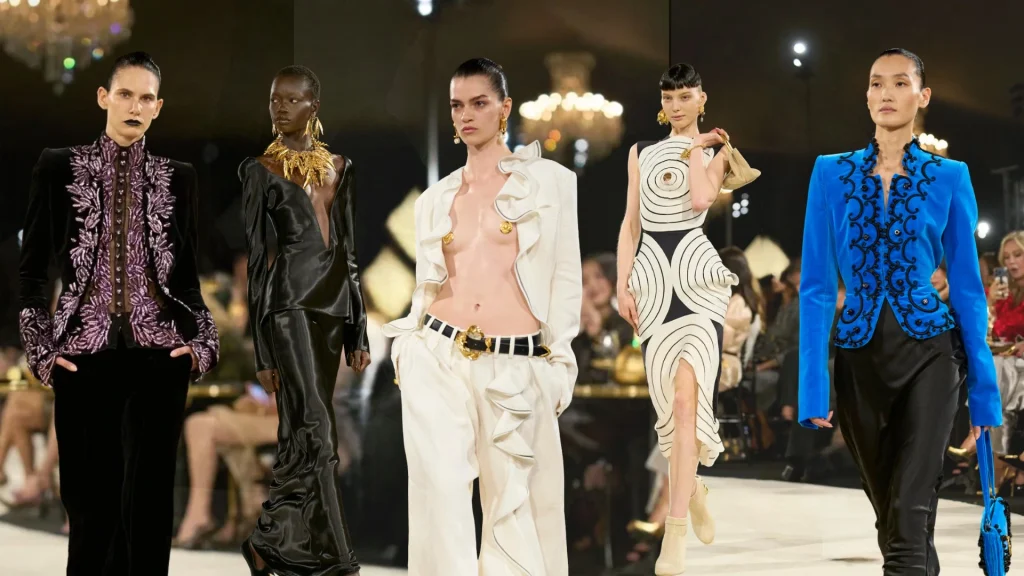
Schiaparelli is one of the most atmospheric Paris Fashion Week shows.
6. Maison Margiela brings experimentation closer to reality
Glenn Martens described the collection as an attempt to identify the essential contradictions within Margiela – hard against soft, ordinary against strange – while translating those concepts into pieces that would not intimidate a wider audience.
Classic house archetypes remained recognisable but were shifted slightly off balance. Florals inspired by 1960s brocades appeared on long column skirts, construction details were exposed, and familiar clothing was altered without losing its usefulness.
That more commercial direction did not mean Margiela had abandoned experimentation. Instead, it reflected one of the central tensions across Paris Fashion Week Spring/Summer 2027: designers increasingly seemed interested in proving that creativity and wearability do not need to exist on opposite sides of fashion.
7. Elie Saab turns lingerie dressing into modern Old Hollywood
Elie Saab brought unapologetic romance to the week. Wildflowers covered the runway, while tiny flowers were placed on models’ faces like delicate floral piercings. Against that setting, the collection explored what happens when 1930s Hollywood glamour meets contemporary lingerie dressing.
Bustiers, bralettes, falling straps, slips, lace, beadwork, soft satin, and bias-cut dresses created a feminine mood inspired by Jean Harlow, but the styling prevented the references from becoming purely retro. Leather jackets, visible lingerie layers, and streamlined tailoring kept the Old Hollywood references feeling modern.
The show also connected directly with one of the strongest Paris Fashion Week trends of SS27: a return to femininity through sheer fabrics, lingerie references, fluid silhouettes, and clothes that reveal rather than armour the body.
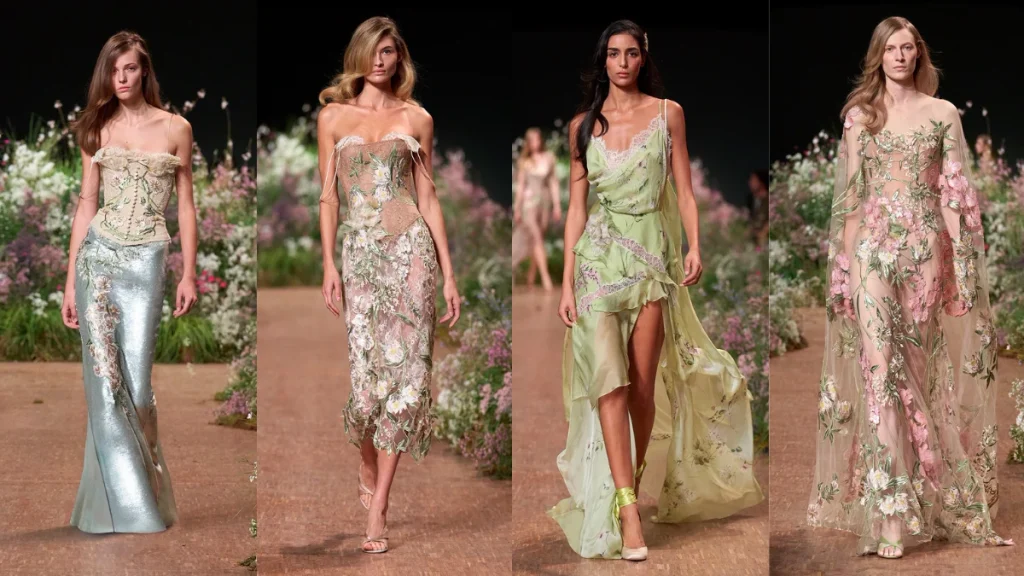
Elie Saab is one of Paris Fashion Week SS27 highlight shows returning to femininity.
8. Balenciaga finds beauty in pragmatism
Pierpaolo Piccioli continued defining his Balenciaga through a meeting of couture technique and ordinary clothing.
White shirts, T-shirts, denim, cargo pieces, leather jackets, and simple separates were manipulated using techniques associated with more formal construction. Jeans were even cut on the bias, something Piccioli noted was new within the house’s vocabulary.
The collection moved between straightforward dressing and dramatic eveningwear without treating the two as separate worlds. It highlighted the contrast between elaborate blouses and simple trousers, cocoon shapes softened with functional details, and an evening finale in which Anok Yai wore flowing pink chiffon with flat Mary Janes.
9. Valentino turns the library into a fashion statement
Alessandro Michele transformed the Bibliothèque Sainte-Geneviève into one of Paris Fashion Week’s most distinctive settings, presenting Valentino through the idea of an “anti-library” filled with unread books and unrealised possibilities.
He compared the concept to a wardrobe of unworn clothes, both representing identities and lives that have yet to be explored. Guests were also asked to bring books for donation to local libraries, making the audience part of the narrative.
For Michele, the literary setting suited his ongoing dialogue between Valentino’s polished heritage and his own eclectic visual language. The show proved how setting and concept can deepen a collection rather than simply decorate it.
10. Matières Fécales makes the political personal
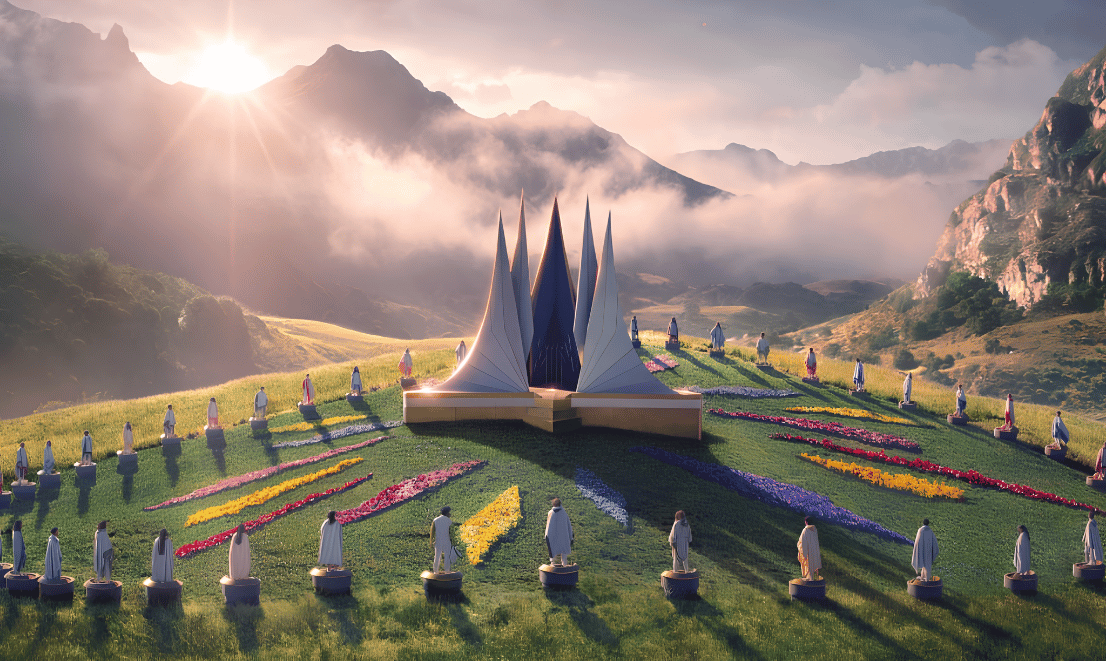
A list of Paris Fashion Week SS27 highlights would feel incomplete if it focused only on the biggest luxury houses. Matières Fécales opened the week beneath the Monument à la République with a collection built around the idea of “the 99%.”
The show featured 99 models of colour, reversing the brand’s previous season, which had satirised extreme wealth and exclusivity. Designers Hannah Rose Dalton and Steven Raj Bhaskaran used the symbolic Paris setting to explore visibility, representation, and who fashion chooses to centre.
The clothes kept the label’s dark, confrontational identity, but the scale and casting pushed the show beyond pure provocation. It became a statement about participation and access in an industry still closely linked to exclusivity.
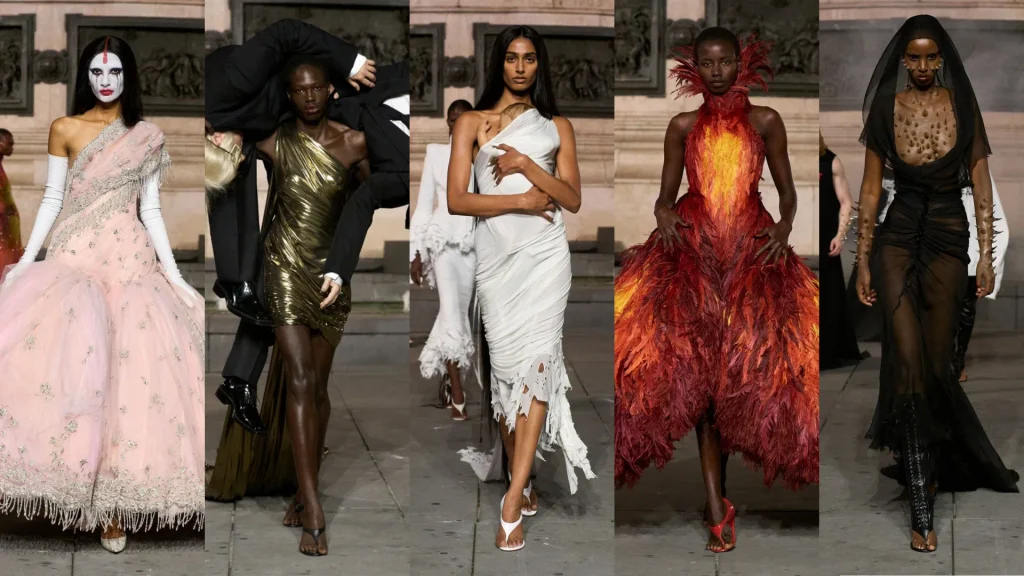
Matières Fécales makes the political personal.
What connected the standout Paris Fashion Week shows?
Despite their differences, several themes connected the strongest collections.
Lightness and wearability emerged as key Paris Fashion Week trends, with Dior softening heritage silhouettes, Balenciaga adapting couture techniques for ordinary garments, Margiela making experimentation more accessible, and Elie Saab embracing fluid, lingerie-inspired femininity.
At the same time, individuality mattered more than one dominant aesthetic. Saint Laurent pursued metallic glamour, Acne Studios embraced historical excess, Schiaparelli refined surrealism, Chanel explored variety and movement, while Valentino and Matières Fécales used fashion to talk about culture and identity.
Experience Paris Fashion Week with MA Hospitality Group
The most memorable Paris Fashion Week shows are only one part of the experience. Throughout the week, Paris also becomes a centre for private brand events, exclusive dinners, exhibitions, designer appointments, after-parties, luxury shopping, and cultural experiences across the city.
MA Hospitality Group can help clients experience the week with greater ease through premium event access, VIP hospitality, luxury hotel bookings, chauffeur-driven transfers, restaurant reservations, private-event arrangements, and dedicated concierge support.
From major houses such as Dior, Chanel, and Saint Laurent to the unexpected Paris Fashion Week SS27 highlights that define the season, a tailored itinerary can transform a busy schedule into a seamless luxury experience. Contact us to begin planning your next Fashion Week journey.


 nana
nana